A guide to exploring my French blogs

Welcome to my blog! I’ve now finished all my entries for my French blog (these are the ones I’m being assessed on), so I thought I’d make a post to make it easier to navigate the entries, in order:

  1. Introductions
  2. Bouchard Père et Fils
  3. Status and international reputation: the keys to Bordeaux’s success
  4. Le Cordon Bleu
  5. Dîner à Paris
  6. Dîner à Epernay, Champagne
  7. Deutz: from vine to glass
  8. Taupenot-Merme
  9. Napoleon’s favourites
  10. Dîner à Institut Paul Bocuse
  11. Yquem
  12. Cité du vin
  13. Au revoir

Happy reading, I hope you enjoy!

xx

Au revoir

The highlight of the final dinner was a 2016 Île de Beauté from Domaine Alzitella in Corsica. However, the rosé is all from the dinner which I feel like mentioning for this final entry. It very hot that evening, and I was feeling quite ill and small on appetite, so I didn’t eat much.

IMG_1172


Instead I’d like to reflect on a theme which kept recurring for me during trip: French culture and vegetarianism. I struggled to eat properly during this trip, particularly in the latter half.

Classic French cuisine, as I’ve already reflected, is ill-equipped to handle vegetarian dietary needs (thankfully I’m not vegan!). Why this rigidity? It’s very ingrained in French culture. The opinion of a French woman I met on a bus in Italy was that France is just “not ready” for vegetarianism.

Obviously, I needed to assert my dietary needs more. However, there were two considerations weighing on me. Firstly: what is my position as a foreigner to impose my standards on a restaurant which clearly advertises itself as French?

The second consideration is that repeatedly explaining vegetarianism to people is tiring, and don’t like feeling like such a nuisance. Back home, it’s very well understood. In France, you have to explain everything “vegetarian… eggs and dairy are ok… no, I don’t eat fish”, then, because you’re already being a pain, the prospect of asking for something tasty or nutritious which you haven’t already had a dozen times over the past two weeks, is usually too much. Even sometimes when you’ve explained everything, you’ll still get an oeuf meurette with bacon in it, or you’ll get the same risotto and fish course everyone else got, but without the fish.

The last difficulty, was the necessity to experience French cuisine, as a group. We were there to study French food, wine and culture.

If I were to do this trip again, to ensure I eat right, (something more important than I initially realised when you’re drinking so much wine) we would either have to be prepared for a thorough explanation at every restaurant, or more likely, I would need to stock up on supplementary items to have outside meal times.

While I learned and experienced a lot about French food, wine and culture, I didn’t get the same gastronomical experience everyone else had. I probably was never going to. I did however, learn an incredible amount from some incredible people in the industry, I got to travel with a lovely group of people, and of course, I tasted some very nice wine!

Cité du Vin

What comes to mind when you look at this building?IMG_1099

Probably many things, although hopefully one of them is a decanter. This building is the Cité du Vin.

To me, it’s a mixture of MONA (in Tasmania) and Scitech (or Scienceworks), but with one sole focus: wine. With numerous interactive, educational, thought-provoking and entertaining exhibits, the Cité was a futuristic mixture of science and art. The Cité seemed to cover everything – from the scientific to the economic, historical and cultural, and everywhere in between.

You could “sit down” at a table with an expert’s hologram who would tell you about their area of wine expertise. There were exhibits for kids, there was a ‘wine erotica’ section (definitely not for kids), there was a table where you could smell aromas by squeezing a pump and then having to guess what they were, there were various short movies.

My favourite film skit was the Banquet of Legends, with famous wine characters throughout history, ranging from Pliny to Napoleon, to Maria Callas, to Churchill. My favourite line from this skit was delivered to an indignant Thomas Jefferson: “what did America bring to the world of wine? Phylloxera?!”

banquet of legends

The “Banquet of Legends”

The most incredible thing for me was the multidimensionality of the experience. Each person had their own device and headset where they could interact with the exhibits in their own language.

IMG_1115

Me, in the Cité, being amazed by the technology

I had a surreal experience at an interactive video exhibit which I was listening to in English, but the girl next to me was listening to in French. I was amazed at how we were laughing and reacting to the same thing, in real time, in two completely different languages. It made me consider what travelling would be like without the issue of language, like if everyone had an instant translation device.

There was also a fascinating temporary art exhibition I don’t have time to write about, but will share with you, my favourite work.


Yquem

If there was one wine and one visit which stood out amongst all others we experienced in the two weeks, it was Château d’Yquem. I am very partial to fortified wines and stickies, but it was also one of our most comprehensive and engaging tours of a chateau.

9f270c4e-e0b5-408e-a642-e57babde2282.jpg

Château d’Yquem was owned by the d’Yquem family from 1593 until 1999 when luxury brand giant, Louis-Vuitton-Moet-Hennessey took over. Thankfully, the wine is still of exceptional quality.

Bordeaux is most famous for its big, dry red wines, however, Chateau d’Yquem makes only white wine, and mostly just sweet white wine from Semillon and Sauvignon Blanc. It is the most prized label of the Sauternes appellation, garnering the sole spot of the top rank in the 1855 Sauternes and Barsac classification.

sauternes map

The foggy weather, often a potential worry for grape growers, is the big secret to Yquem’s success. The fog creates damp, moist conditions which spur the growth of botrytis, or ‘noble rot’, a fungus which intensifies the sweetness and adds flavours like honey and ginger to the wine.

Harvest at d’Yquem can take anywhere between nine days to two months (Bordeaux’s Medoc region usually takes two-three weeks). There are at least two waves of picking, but often more, with pickers handpicking the botrytised grapes by the berry, and leaving the non-botrytised grapes on the bunch. This singularity of attention translates to the ferment too. Each day’s pickings are fermented and monitored separately. Imagine the multitasking required by the cellar master – last year there were 48 picking days!

Tasting d’Yquem is an experience I won’t forget in a hurry. We had a 2013, a year of a dry summer and a cool September picking season. It was lusciously sweet, well-balanced and complex, with a velvety texture unlike any sticky wine I’d had before. The nose was like a “tropical fruit salad”, with passionfruit, apricot, orange peel, peach, mango as well as honey, acacia and toasty vanilla.

If one half bottle wasn’t going to set me back €175, I would have bought as many as my luggage limit allowed.

Dîner à Institut Paul Bocuse, Lyon

I believe this is the best dinner we had. Institut Paul Bocuse is a culinary training institution, which means you can get top quality food, at affordable prices. If you’re ever in Lyon, I recommend you check it out.

2A85E20C-BC2C-4C70-81AB-3B7E2FB72337

Our table, before the meal

Dinner at the Institut was much more in the “cuisine nouvelle” style than the rich, heavy and sauce-laden traditional French style of “cuisine classique”. This makes sense, because Paul Bocuse was one of the most integral figures to this movement. He was said to have first coined the term in 1969 in helping design the meal for the maiden flight of the Concorde. It is a French wave of cooking which emphasises freshness and lightness, as well as beautiful presentation on the plate.

My entrée was eggplant caviar with salad and mango coulis. The intriguing preparation was incredibly refreshing. The pairing for this dish was very satisfying, with the 2015 Saint Joseph Marsanne Roussanne from the Côté du Rhône, helping bring out the freshness of the salad.

5D42C883-1003-4D6E-9FF6-DB193CCE2338

Main course may have been a vegetable assiette, but it was by far the best vegetable assiette I’d ever had. Each element on the dish were cooked and seasoned to perfection. There were mushrooms, artichokes, beetroot, asparagus (of course), and an apple, cinnamon and vanilla puree.

7321F901-59AA-4055-9C4D-65DDFDB8F513

Dessert was spectacular and delicious. It was apple inspired, in the sense that it looked and tasted like an apple, and parts of it were apple, but it was not an apple. This paired very nicely with our first sweet dessert wine of the trip, a 2014 Domaines des Bernardins Beaumes-de-Venise Muscat.

Now, not to be a name dropper or anything, but I should let you know that I was lucky enough to meet Paul Bocuse himself at the Fresque des Lyonnais the next morning.

858B0C20-9916-478A-AF2D-05D644DD2E70

Paul Bocuse (centre, in chef’s hat) and myself

Napoleon’s favourites

Our regional dinner in Burgundy was set in a rustic, Burgundian restaurant called La Ciboulette.

The restaurant had a charming atmosphere, and you could tell that it was frequented by locals, even if only from our lecturer Ken’s swift ability to find a couple enthusiastic to sing with and conduct us in multiple verses of the traditional Burgundian song, “The Knights of the Round Table”. I was initially expecting Monty Python, but alas, “Les chevaliers de la table ronde” is a different tune, dating back centuries earlier.

In terms of the food, the entrée of oeuf meurette was classic Burgundian fare, hearty and tasty, although the main course of vegetable assiette was disappointing to say the least. The dessert course was a mixture of apple and chocolate, and as with most French desserts, it was most agreeable.

The highlight of the dinner for me were the cheese and wine pairings. It was myself and Jarrah’s turn to choose the wines for the group. Unsure of what cheeses were to come, we chose the wines for mostly sentimental reasons, and were pleasantly surprised.

0031F160-F4F5-47D5-8252-B7BFD61D418A

The 2014 Roland Lavantureux Chablis paired superbly with the chèvre. The high acid of the Chablis cut through and balanced the creaminess of the goat’s cheese incredibly.

The 2014 Domaine Marchand-Grillot Gevrey-Chambertin, we chose for the Napoleonic connection. We’d guessed (rightly) that we would be having Epoisses, and we thought it would be poetic to have Napoleon’s favourite wine with his favourite cheese. It seems Napoleon was on to something! Epoisses is a notoriously difficult cheese to match with wine, given its strong flavour, yet, the fruitiness and subtle earthiness of the Gevrey-Chambertin, in combination with the Epoisses, created a new, sensational dimension of flavour which brought out the most attractive notes in both wine and cheese.

Taupenot-Merme

A stark contrast to the glitz of Champagne, Burgundy was rustic and down-to-earth. Each house was generally on a much smaller scale, with a greater importance on family connection.

We had a variety of experiences again, tasting tank, barrel and bottle at Ropiteau Frères, touring the domain of Clos Vougeout, seeing the larger-than-life (but still in construction) winery of Jean-Claude Boisset, despite the disappointing wines, and having a guided tour and comprehensive tasting at Bouchard Père et Fils.

Virginie from Taupenot-Merme had my favourite stories though.

This was our first stop in Burgundy, and already, the contrast was striking. No grand chateau, just some very expensive vines humbly presented from Virginie’s back door.

IMG_0452.JPG

Take for example this premier cru plot in Virginie’s backyard.

IMG_0456

Premier cru, being the second highest classification Burgundy vines can achieve, is a coveted designation. Not only was this plot nonchalantly sitting in a backyard, it was also underappreciated by Virginie’s children who had kept asking if they could turn it into a swimming pool!

Can-We-Getz-A-Bigger-Swimming-Pool-Funny-Meme

The most striking thing about Virginie’s vines was the grand cru vineyard hanging out just over her fence, no more than 20 metres from her premier cru plot. The owner of most of this vineyard was luxury brand giant Louis-Vuitton-Moet-Hennessy (LVMH). It is stopped from owning all 8.5ha of Clos de Lambrays only due to Taupenot-Merme owning just 0.43ha of the appellation. This tiny parcel of land may only produce around 200 bottles a vintage, but maintaining this designation is an act of defiance against LVMH’s powerful influence on the wine world.

EA3A294C-3050-4FF7-AFF8-A17F94A71D1C

Clos de Lambrays

Being able to claim your wine as “Monopole” is a powerful marketing tool in claiming exclusivity (and thus, a higher price). Virginie could receive a fair sum for the tiny parcel of land, but the family history, connection to the land and the passion makes the plot priceless.

Deutz: from vine to glass

Over the 3 days we spent in Champagne, we’d seen some amazing places: the grand caves of Pommery, the modest family-owned Ellner, the warm and welcoming house of passionate Evelyn Boizel, the swish cellars of Lanson and, the incredible vineyards of Philipponnat. We finished off with Deutz, which I really appreciated because it helped connect the dots altogether.

Deutz, owned by Roederer (the makers of Cristal) are a historical place because they were the site of the 1911 Champagne Riots. These riots were a hugely influential set of labour disputes which led to the establishment of the AOC laws protecting the appellation of champagne.

3D6C75E4-AF27-4E5C-A86E-8E2029D9C5F7.JPG

The site of the Champagne Riots, the back street to Deutz

After the tour of the original 19th century château, we visited the winery. Here, we saw the most comprehensive bottling process out of all the houses we’d seen. We saw not only the initial bottling where the crown caps are affixed for the bottles to be set “sur lees”, we also saw the final bottling which follows the secondary ferment. I was so grateful I saw this final bottling because it included the disgorgement process, something I’d had such trouble picturing until that point.

CDDFDD54-3360-4503-8152-BE817FF9AC6B.JPG

The disgorgement machine. Check out this video here to see the whole process of how champagne is made.

Following the winery, we took an extensive walk through the dark and cool cellars. A very romantic atmosphere, made even more so, by our final exit from the cellars, whereby we took a candle lit path to magically surface in the tasting room of the château.

Our finale to the Deutz visit included a tasting, followed by an exquisite, three course, champagne-paired lunch. While I feel ill-equipped to comment on the meat-filled savoury dishes, the pairing of the demi-sec sparkling rose with the raspberry macaron dessert was phenomenal. There was just enough sweetness in the wine to appeal to the sweetness in the dessert, while adding another champagne-layered complexity.

0ABD87D8-0AE3-4E27-AFC7-9C4E135C4A91

Diner à Epernay, Champagne

Our first night in Epernay, we were treated to a dinner at the Michelin-starred restaurant: “Hotel Les Berceaux”.

The Michelin Guide is the premier guide to all the best restaurants in France and around the rest of the world. The most you can get is three Michelin stars, but even having one Michelin star is very good. You can get your own Michelin guide in most service stations around France, as ours would sell street directories, or, you can check out the online version.

The Guide was certainly right about Les Berceaux! The food was spectacular, speaking for both presentation and taste, and the service was excellent. It was also a great example of how the French can do vegetarian food well, and I really appreciated the extra effort.

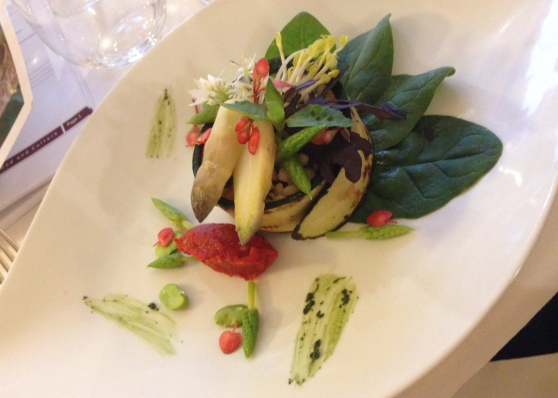
My favourite course was the entrée with lightly grilled zucchini and tomato, garnished with white asparagus (of course, because it’s in season!).

ab3c2e15-3ed3-49cf-9124-27a810326d45.jpg

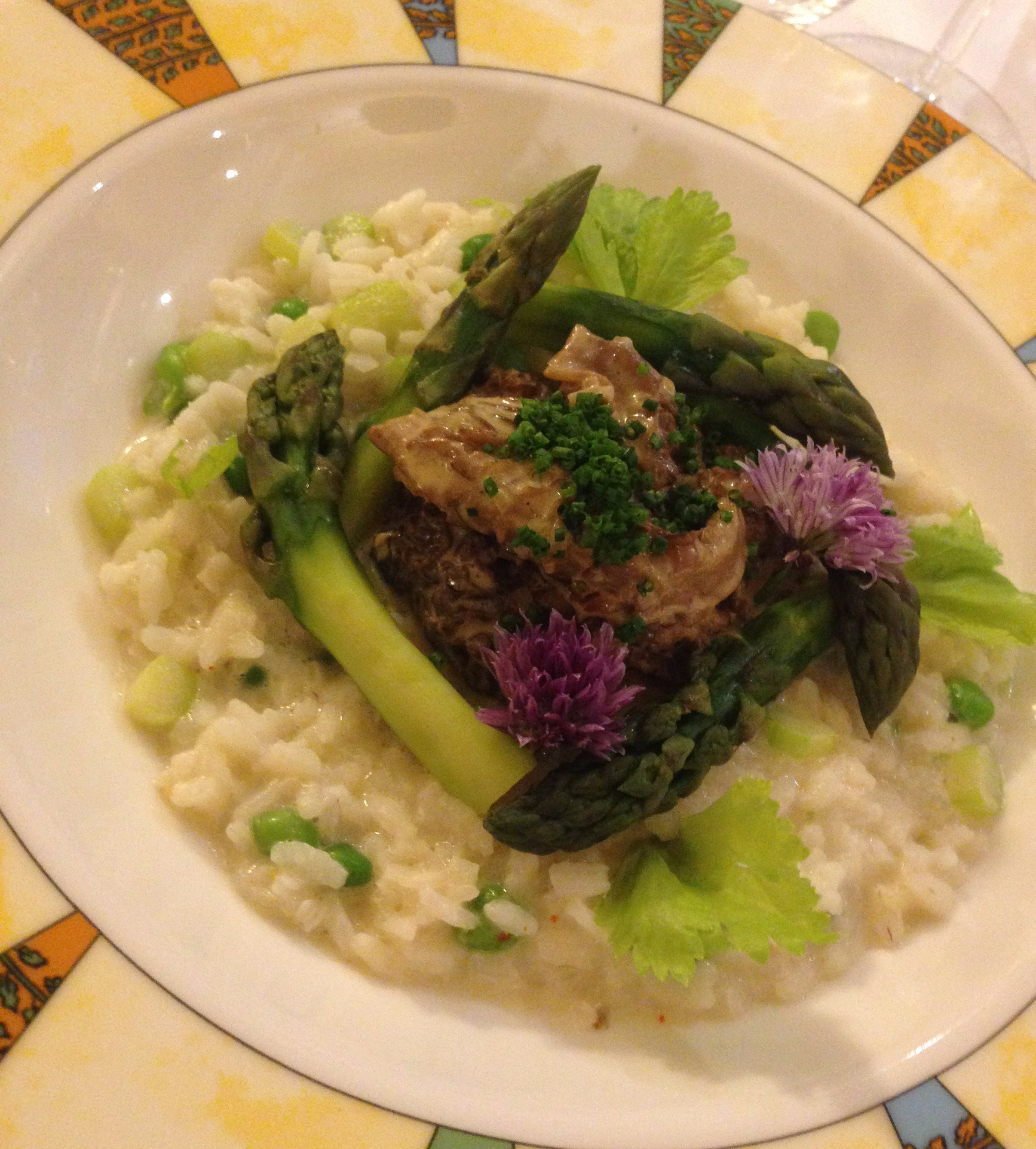
The main course of green bean risotto with asparagus and mushroom was also very nice too.  It was different to the Italian style risotto I’m more used to as the rice was grainier and the sauce milkier, yet these differences helped join the asparagus and mushroom together better.

c639cae6-d89b-430e-b4d1-1fa6330e719f.jpg

If you count the amuse bouches and petit fours, there were at least seven courses all up, all of it very tasty!

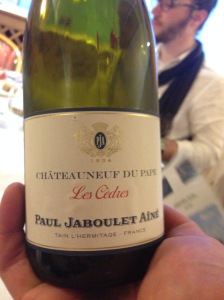
The most interesting wine we had for this dinner was a white Châteauneuf du Pape (Paul Jaboulet Aîné, Les Cèdres 2014). Most people who think about Châteauneuf du Pape recall the red wine, and given that 95% of this coveted appellation is red, you could be forgiven. However, the rarer white grapes, in this case Grenache blanc and Clairette, make a beautiful and often complex wine, typically with good acidity and notes of white flowers, stone fruit and citrus.

84CA02D7-B14D-46E1-AD12-7D643390DFE9

Dîner à Paris

France doesn’t seem to know what to do when it comes to vegetarian food. For the main course, there appear to be three options: vegetable assiette, risotto and vegetable assiette.

hotel du nord.jpg

The iconic Hôtel du Nord, the site of our Paris dinner

At our first dinner in Paris, I was treated to a “salade mixte” (mixed salad) for entrée and a “legumes assiette” (plate of vegetables).

The salad was uninteresting and seemed better suited as a side dish, but the vegetables in the assiette were cooked well and were quite tasty.

With this being my second time to France as a vegetarian, the lack of options was expected. Meat is the star of most French dishes and the French are unaccommodatingly proud of their cuisine.

“Modern Australian” fine dining restaurants aren’t much better. Even though Australian cuisine is less traditional, it’s the French who defined the concept of “haute cuisine” and this influence is arguably the most prominent in our conception of ‘fine’ cuisine. When I used to work in “Modern Australian” fine dining, our menu’s only vegetarian options for main course were (no surprises for guessing): risotto and vegetable assiette.

One of my favourite things about eating out however is the food and wine pairing. Choosing the right match can transform the experience of both drink and dish.

For example, two of the wines I had with dinner, a 2015 Sancerre and, a 2014 Vacqueyras from Domaine des Ondines in the Rhone Valley. The Sancerre was aromatic, sharp and clean and brought a subtle complexity to the asparagus, sweet potato mash and chips, without overpowering. The Vacqueras was bold yet well balanced with a fruitiness, acidity and developing spice which complemented the potato rosti and artichoke. I’m glad I had both wines to experience the difference!